
A Practical Apporach to Social Recruiting
A hands-on approach to social recruiting — the workflow, targeting and measurement tactics modern TA teams use to convert passive candidates at scale.
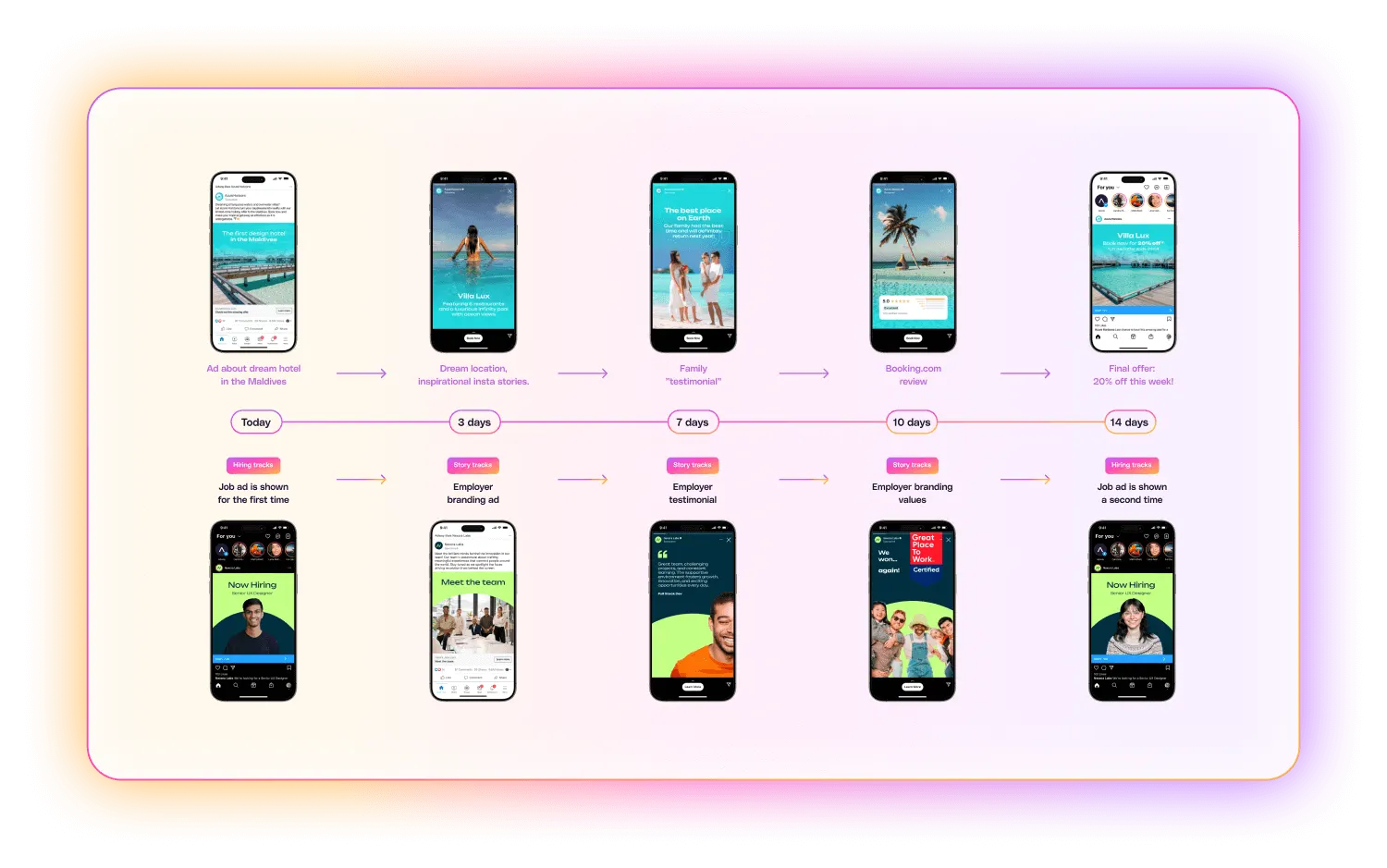
The Expanding Role of Social Recruitment
Social media has become deeply embedded in how organisations attract and engage talent. While professional networks remain important, recruitment activity has expanded well beyond a single platform. Visual, community-driven, and mobile-first environments now play a significant role in how candidates discover employers and evaluate opportunities.
This shift presents both opportunity and complexity for talent acquisition teams. Social platforms offer access to audiences that may never visit job boards, but they also demand a different approach to messaging, content, and consistency. Recruitment campaigns that perform well tend to balance creativity with structure, ensuring that visibility translates into meaningful engagement rather than surface-level attention.
Effective social recruitment campaigns focus on relevance. They meet candidates in environments where discovery feels natural and use formats that align with platform behaviour. When supported by data and scalable systems, these campaigns become repeatable rather than one-off experiments.
Influencer Collaboration as a Recruitment Channel
Influencer partnerships have become a recognised component of social recruitment when applied with care and intent. Their value lies in trust. Audiences follow creators by choice, often engaging with their content over time, which lends credibility to messages shared through these channels.
One widely referenced example comes from large organisations using lifestyle or purpose-driven creators to explore themes such as development, belonging, or long-term opportunity. These collaborations focus less on direct promotion and more on storytelling, allowing creators to interpret messages in a way that feels natural to their audience.
Platform Context and Audience Alignment
Platform behaviour matters significantly in influencer-led recruitment activity. Channels such as TikTok and Instagram support informal, narrative-driven content and are particularly effective for reaching early-career and emerging talent. Professional networks serve a different purpose and are not always suited to influencer-style storytelling.
Successful campaigns align creator voice, platform norms, and employer message. This alignment reduces friction and increases credibility. The emphasis remains on resonance rather than reach alone.
Influencer collaborations require careful selection. Long-term value depends on shared values and authenticity rather than short-term visibility. When creators are treated as partners rather than distribution channels, campaigns are more likely to support employer brand perception and candidate interest.
Simple Campaign Activations That Encourage Participation
Not all effective recruitment campaigns rely on large-scale partnerships. Some of the most engaging initiatives are built around simple, accessible prompts that invite participation.
Employee-led storytelling campaigns, short-form video prompts, or creative challenges often succeed because they lower the barrier to entry. When participation feels straightforward and purposeful, engagement increases organically.
Campaigns built around personal perspective rather than corporate messaging tend to perform well. Employees sharing why they joined, what they work on, or how they collaborate offers candidates insight that traditional job descriptions cannot.
Why Simplicity Works
Simple activations work because they are easy to understand and easy to join. Clear purpose, minimal friction, and visible outcomes encourage participation. This approach also supports authenticity, as contributors are not constrained by overly rigid formats.
From a recruitment perspective, these campaigns still require structure. Monitoring engagement, tracking traffic, and understanding how activity translates into applications ensures that creative ideas deliver measurable value.
Social recruiting technology supports this balance by providing visibility into performance without adding operational complexity.
Recruitment Beyond a Single Platform
While LinkedIn remains central to many recruitment strategies, it no longer represents the full picture. Other platforms play distinct roles in reaching different audiences and supporting varied campaign objectives.
Instagram, TikTok, and Facebook offer environments where employer brand discovery happens passively. Content encountered in these spaces often shapes perception long before a candidate considers applying for a role.
Maintaining presence across multiple platforms supports consistency and reach. It also allows recruitment teams to adapt messaging to platform-specific behaviour rather than applying a single approach everywhere.
Platform-specific activations, such as short-form video challenges or behind-the-scenes content, help messages feel native rather than adapted. This alignment improves engagement and reduces the sense of interruption.
Structuring Social Recruitment Campaigns
Successful social recruitment campaigns benefit from clear structure. This does not limit creativity but ensures that activity can be repeated, measured, and improved over time.
Key components include:
- Defined campaign objectives, such as awareness, engagement, or application
- Platform-specific content formats
- Clear calls to action aligned with candidate behaviour
- Consistent employer brand representation
- Performance review and optimisation cycles
- Without structure, campaigns risk becoming isolated efforts that deliver attention without long-term value. With structure, creativity becomes scalable.
The Role of Technology in Scaling Social Campaigns
Creative ideas alone do not guarantee consistency or performance. As recruitment activity scales across roles, regions, or platforms, manual execution becomes difficult to sustain.
Social recruiting technology addresses this challenge by connecting creative execution, distribution, and performance insight within a single workflow. Adway supports this by enabling recruitment teams to manage social recruitment campaigns across platforms while maintaining brand control.
Campaign assets can be created using structured templates designed for social formats. These creatives adapt across platforms, roles, and locations without requiring repeated manual work. This approach supports consistency while allowing variation where needed.
Data-Led Optimisation of Campaign Performance
Performance insight is essential to improving social recruitment outcomes. Engagement metrics alone provide limited value unless connected to candidate quality and downstream outcomes.
Adway provides visibility into how campaigns perform across platforms, formats, and audiences. This insight supports informed adjustments to targeting, creative, and budget allocation.
Rather than relying on instinct, recruitment teams can refine campaigns based on evidence. Over time, patterns emerge that guide future strategy and reduce reliance on trial and error.
Supporting Employer Brand Without Losing Authenticity
Automation and optimisation do not need to compromise authenticity. The most effective social recruitment campaigns retain human voice while benefiting from structured delivery.
Adway supports human-in-the-loop workflows, allowing teams to review content where appropriate and ensure tone and messaging remain aligned with employer values. Platform-specific templates also ensure that content feels natural in each environment.
This balance allows recruitment teams to maintain creative control while benefiting from scale and efficiency.
Measuring Success Beyond Visibility
The success of social recruitment campaigns is ultimately measured by outcomes rather than attention. Application quality, time to hire, and retention indicators provide more meaningful signals than reach alone.
By connecting campaign activity to recruitment systems, teams gain a clearer understanding of how social engagement contributes to hiring outcomes. This visibility supports better planning and resource allocation.
Over time, social recruitment becomes a predictable and optimisable channel rather than an experimental one.
A Structured Future for Social Recruitment Campaigns
Social recruitment campaigns are no longer optional additions to hiring strategies. They are an integral part of how organisations communicate, engage, and attract talent.
When built on clear structure, authentic content, and data-driven optimisation, these campaigns support quality hiring outcomes at scale. Technology such as Adway enables this by connecting creativity with performance insight and operational efficiency.
Rather than focusing on isolated campaigns, recruitment teams benefit from building repeatable frameworks that evolve over time. This approach supports consistency, relevance, and sustained engagement across platforms.
Social recruitment succeeds when creativity and structure work together. With the right systems in place, campaigns move beyond visibility and become a reliable driver of long-term hiring success.
Related reading
-
Social Recruitment Campaigns: Practical Approaches for
-
AI Social Recruiting: Transforming Hiring Through Data and Efficiency
-
Social Recruitment Campaigns: Practical Approaches for Modern Teams
-
Social Sourcing in Modern Recruitment: Building Quality Pipelines Through Social Channels
Want to see this in practice?