
The Comprehensive Guide to Social Recruiting Ads
Discover how social recruiting ads are revolutionizing talent acquisition by leveraging targeted social media campaigns for efficient and effective hiring.
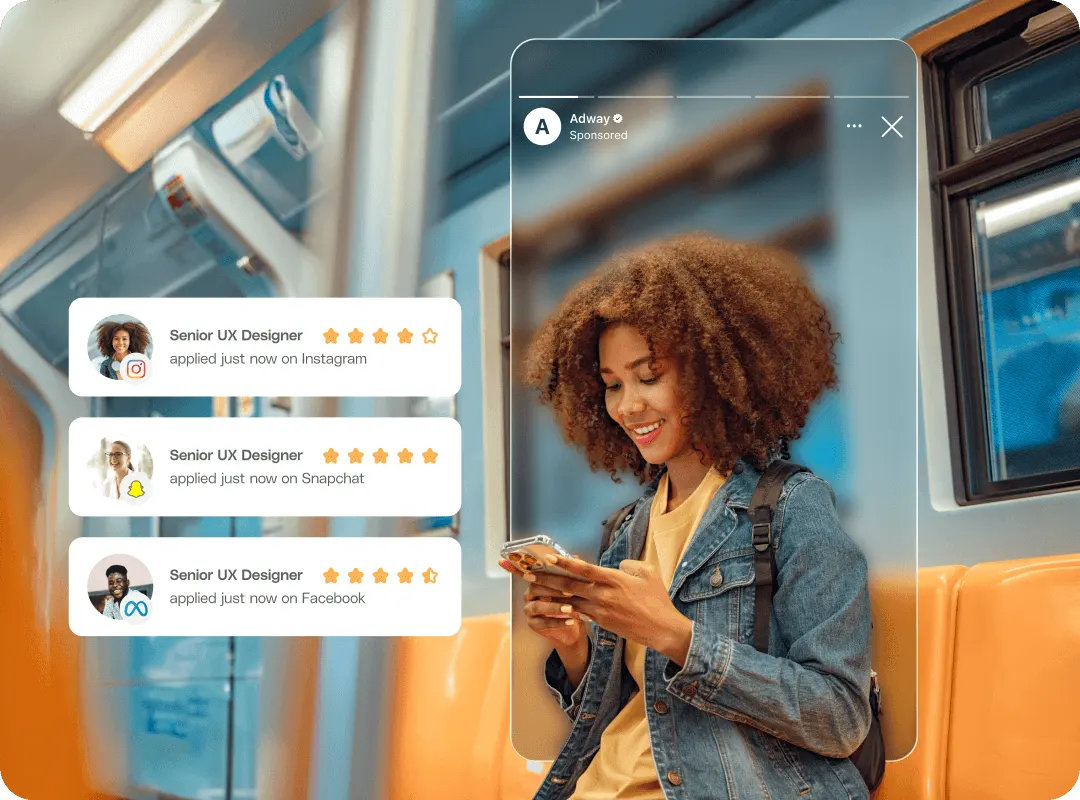
The Role of Social Recruiting Ads in Modern Hiring
Social recruiting ads have transformed how talent acquisition teams connect with candidates. By leveraging social media platforms, these ads make it possible to reach untapped and passive talent more effectively. The mechanics of social recruiting ads are explored across formats, cost models, targeting options, and the platforms that consistently deliver the strongest results, alongside how Adway’s social recruiting technology supports and strengthens campaign performance.
How Social Recruiting Ads Work
Social recruiting ads work by using paid advertising tools on social platforms to attract job candidates. These ads are built specifically for recruitment, not general marketing. Common formats include feed ads, story ads, carousels, and videos. Success depends heavily on using the right bidding models, particularly cost-per-click (CPC) and cost-per-thousand impressions (CPM).
Strong examples include Facebook feed job ads and LinkedIn sponsored job posts. To get results, it’s important to match the ad format to the job persona. Clear visual design and direct calls to action can make a big difference. One common issue is targeting too broadly, which can weaken the impact. Another is skipping mobile optimisation, even though most candidates engage through their phones.
Costs of Social Recruiting Ads
Knowing the cost of social recruiting ads helps plan your budget with more control. Prices vary by platform. Facebook ads typically cost between $0.50 and $2.00 per click. LinkedIn ads are more expensive, often landing between $5 and $8 per click. On average, monthly spend falls somewhere between $850 and $2,000, not counting creative production or campaign management fees.
If you overlook added costs like creative work, campaign setup, or A/B testing, you might face surprise overruns. It’s smart to benchmark using average industry CPC rates. This gives a more accurate picture and helps set clear expectations during planning.
Targeting Options and Platform Choice
Targeting and platform choice are key to running successful social recruiting ads. Usage rates vary between employers and job seekers on each platform. LinkedIn, for example, is used by around 79% of employers for professional roles. It’s well suited for recruiting in that space. Facebook, with about 71% employer usage, works better for broader or high-reach campaigns.
You can tailor your targeting based on job role, required skills, or candidate demographics. Using multiple platforms reduces the risk of depending too heavily on one and helps you reach different candidate groups. Adway’s social recruiting technology supports this process by streamlining platform use and refining targeting strategies.
Examples of Effective Recruitment Advertising
Social recruiting ads tend to be more cost-effective than traditional methods. A meta-analysis shows an odds ratio of about 1.97, meaning social ads are nearly twice as efficient per recruited participant. The median cost per participant using social media is $45.51, compared to $74.89 for traditional recruitment efforts.
These findings highlight how important it is to focus on cost-effectiveness, not just total cost. This way, talent acquisition leaders can choose the most efficient channels for their goals. It’s important not to assume social recruiting is always the cheaper option. Other factors still matter when evaluating the total value.
How Adway Supports Social Recruiting Ads
Adway plays a practical role in helping teams turn social recruiting into a repeatable, high-performing process. By automating targeting optimisation, performance measurement, and cross-platform ad management, the platform reduces operational complexity while improving consistency across campaigns.
The results are driven by candidate relevance rather than application volume. Organisations using Adway generate an average return of €194 for every €1 invested, supported by campaigns that attract candidates who align more closely with role requirements and organisational context. Higher relevance at the top of the funnel leads to stronger shortlists and more efficient hiring decisions downstream.
Excluding social recruiting technology from a hiring strategy increasingly limits performance insight. Adway centralises real-time data across platforms, enabling clearer ROI attribution and more informed decision-making. This allows talent acquisition teams to adjust strategy based on evidence, not assumptions, and to scale social recruiting without compromising candidate quality.
Making Social Recruiting Ads Work at Scale
Social recruiting ads give talent acquisition teams a powerful way to engage candidates using tailored, platform-specific campaigns. Their success depends on using the right ad formats, understanding how costs work, and aligning audience targeting with each platform’s strengths. Adway’s social recruiting technology strengthens these efforts by automating complex steps like targeting and tracking, while also making campaign management simpler. With the right tools, organisations can tap into passive talent more effectively and make the most of what social platforms offer.
FAQs
How much does a social recruiting ad cost?
The cost of a social recruiting ad varies by platform, audience, and competition. On Facebook and Instagram, cost per click typically ranges from $0.50 to $2.00. LinkedIn advertising is generally more expensive, with cost per click often falling between $5 and $8 due to its professional targeting and higher demand.
Monthly spend for social recruiting campaigns commonly sits between $850 and $2,000, depending on hiring volume and role complexity. Many organisations also allocate an additional 10 to 20 percent for campaign management or optimisation support.
Which social platform is most commonly used for recruitment?
LinkedIn is the most widely used platform for recruitment, particularly for professional, specialist, and senior roles. Around 79% of employers use LinkedIn as part of their hiring strategy. Facebook is also heavily used, with approximately 71% of employers leveraging it to reach broader and more diverse candidate audiences.
Platform choice often depends on role type, seniority, and target demographics rather than a single universal best option.
Are social recruiting ads more cost-effective than traditional recruitment methods?
In many cases, yes. Research indicates that social recruiting ads can deliver significantly higher efficiency than traditional recruitment channels. An estimated odds ratio of 1.97 suggests that social recruiting approaches can generate nearly twice the return per dollar spent compared with non-social methods.
This improved efficiency is largely driven by better audience targeting, lower distribution costs, and the ability to reach passive candidates who are not actively searching on job boards.
Related reading
-
The Essential Guide to Recruiting Email Automation
-
AI Social Recruiting: Transforming Hiring Through Data and Efficiency
-
Social Sourcing in Modern Recruitment: Building Quality Pipelines Through Social Channels
-
Weighing the Pros and Cons of Social Recruiting: An Objective Analysis
Want to see this in practice?