
Social Recruiting Software That Works with Your ATS
Discover how Adway enhances your recruitment stack by automating and optimizing social recruiting, seamlessly integrating with your ATS and CRM to improve hiring outcomes.
Talent acquisition is under pressure to evolve. Hiring volumes fluctuate, roles become more specialised, and candidates expect faster, simpler experiences across digital channels. At the same time, TA teams are expected to deliver measurable outcomes while working with leaner resources and increasingly complex compliance requirements.
For many organisations, this pressure leads to a reassessment of the recruitment technology stack. Questions surface around whether the current ATS system, CRM, and recruiting software are still fit for purpose. In particular, teams are asking whether their setup supports how hiring actually happens today, especially across social platforms where much of candidate discovery now takes place.
Adway sits within this shift. Rather than replacing an ATS or CRM, it strengthens the recruitment stack by automating and optimising social recruiting as a structured, measurable channel. Looking ahead to 2026, there are clear reasons why Adway is increasingly relevant for organisations reviewing how their recruiting software needs to perform.
The Changing Role of ATS and CRM Systems
Applicant Tracking Systems and recruitment CRMs remain central to hiring operations. They store candidate data, manage workflows, support compliance, and enable collaboration across recruitment teams. For most organisations, these systems form the backbone of recruitment.
However, ATS systems were not designed to handle modern social recruiting at scale. They excel at managing applicants once they enter the funnel, but they offer limited support for how candidates are sourced, attracted, and engaged before applying. As a result, many teams rely on manual posting, disconnected ad tools, or agency support to fill that gap.
This creates inefficiency. Recruiters spend time duplicating work across platforms. Performance data is scattered. Social recruiting becomes difficult to measure and even harder to optimise. Over time, this limits both reach and quality of hire.
Adway addresses this gap directly. It integrates with existing ATS and CRM systems, allowing social recruiting activity to connect seamlessly with the rest of the hiring workflow. Rather than working around the ATS, social recruiting becomes an extension of it.
Social Recruiting Is Now a Core Sourcing Channel
Social platforms play a central role in how candidates discover opportunities. For many roles, especially digital, technical, and early-career positions, candidates are more likely to encounter job opportunities through social feeds than through job boards.
This shift has important implications for recruiting software. Social recruiting cannot be treated as a side activity or left to individual recruiter effort. It requires structure, automation, and continuous optimisation to deliver consistent results.
Adway is built around this reality. The platform automates job advertising across major social channels, ensuring roles are distributed consistently and at scale. Campaigns are optimised based on real performance data, allowing teams to maintain visibility without increasing manual workload.
As social recruiting continues to shape candidate behaviour, organisations that lack a structured approach risk falling behind. Treating social as a core channel, supported by dedicated technology, is becoming essential rather than optional.
Quality of Hire Is the Metric That Matters
Recruitment success is no longer defined by application volume alone. High volumes often lead to overwhelmed recruiters, longer screening times, and weaker downstream outcomes. Increasingly, organisations are focusing on quality of hire, retention, and time-to-productivity.
AI-powered recruiting plays a key role here. When applied correctly, AI helps shift focus from volume to relevance. Instead of maximising reach, campaigns are optimised to attract candidates who are more likely to complete applications, progress through the funnel, and perform well in role.
Adway applies AI to social recruiting in this way. Targeting, budget allocation, and optimisation are guided by candidate behaviour and performance signals rather than assumptions or static rules. This reduces wasted spend and improves the overall efficiency of sourcing activity.
Organisations using Adway consistently report stronger returns, including an average of €194 generated for every €1 invested. These outcomes reflect a move away from vanity metrics and toward measurable business impact.
Automation Without Losing Oversight
Automation is a priority for many TA teams, but it often raises concerns around control, brand consistency, and compliance. This is particularly true in enterprise or regulated environments where hiring decisions must be transparent and defensible.
Adway addresses these concerns by automating execution while keeping decision-making with the recruitment team. Job distribution, budget pacing, and optimisation are handled by the platform, but recruiters retain control over messaging, employer brand, and hiring priorities.
Campaigns can be adjusted in real time based on performance data, without restarting workflows or duplicating effort. This balance allows teams to scale activity while maintaining clarity and accountability.
For organisations managing multiple roles, regions, or hiring managers, this approach reduces operational friction without introducing new risks.
Making Social Recruiting Measurable
One of the biggest challenges with social recruiting is measurement. When activity is spread across multiple ad accounts, platforms, and manual processes, it becomes difficult to understand what works and why.
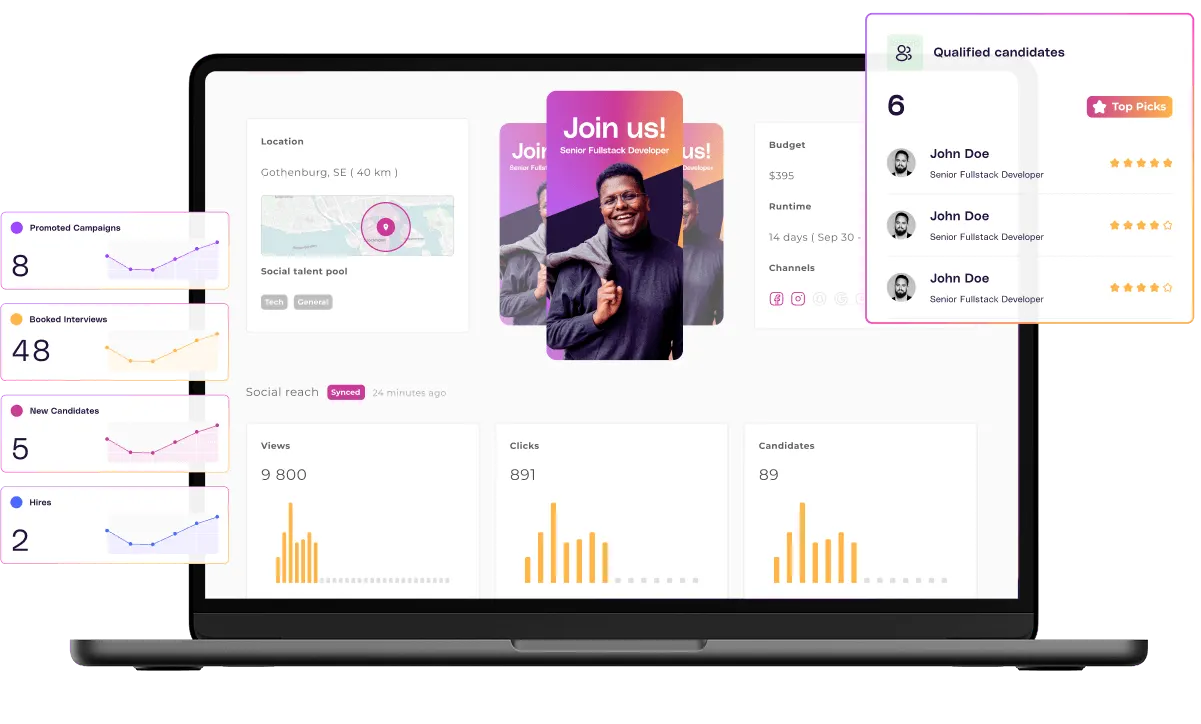
Adway centralises performance insight across social channels. Recruiters can see how roles perform, where spend delivers value, and which campaigns contribute to quality outcomes. This makes it easier to adjust strategy, justify decisions, and report impact to stakeholders.
When integrated with ATS and CRM systems, this insight extends beyond clicks and impressions. Teams can track how social-sourced candidates progress through the funnel, supporting more informed hiring decisions.
This level of visibility is particularly important as recruitment teams are increasingly asked to demonstrate ROI and defend hiring strategies at a business level.
Compliance, Fairness, and Governance
As recruitment becomes more data-led, compliance and fairness remain non-negotiable. Social recruiting involves exposure to personal data, platform algorithms, and potential bias if not managed carefully.
Adway supports more consistent, auditable social recruiting by standardising how roles are distributed and optimised. Rather than relying on individual judgement or inconsistent targeting, campaigns follow defined rules and performance criteria.
This consistency reduces variability in exposure and supports fairer hiring practices. Centralised reporting also makes it easier for TA teams to review activity, identify issues, and intervene when needed.
For organisations operating in regulated industries or across multiple regions, this structure supports compliance without slowing down hiring.
Built to Work with Existing Recruiting Software
A common concern when adopting new recruitment technology is overlap or disruption. Adway is designed to complement existing ATS systems, CRMs, and recruiting software rather than replace them.
Integrations ensure that candidate data flows smoothly into existing workflows. Recruiters do not need to switch systems or manage parallel processes. Social recruiting activity becomes part of the same operational framework as other sourcing channels.
This approach reduces friction during implementation and supports faster adoption across teams. It also ensures that investment in existing recruitment infrastructure continues to deliver value.
Preparing for What Hiring Looks Like Next
Looking ahead to 2026, several trends are already clear. Mobile-first candidate behaviour will continue to grow. Passive talent will remain critical. Recruitment teams will be asked to deliver more impact with fewer resources, while maintaining fairness and compliance.
AI-powered recruiting will play a larger role in managing complexity and improving outcomes. However, success will depend on how thoughtfully that technology is applied.
Adway is built with these realities in mind. Mobile-first candidate journeys reduce drop-off. AI-driven optimisation improves performance over time. Seamless integrations ensure social recruiting connects directly into existing TA systems.
Rather than reacting to each new platform or hiring challenge, teams using Adway are better positioned to adapt without adding complexity.
Why Adway Belongs on the Shortlist
Adway is not positioned as a replacement for an ATS system or CRM. It fills a critical gap by making social recruiting automated, measurable, and aligned with the rest of the recruitment stack.
For organisations reviewing their recruiting software ahead of 2026, the key question is whether their current setup supports how hiring actually happens today. Social recruiting is no longer an experiment. It is a core part of modern talent acquisition.
With its focus on relevance, automation, and performance insight, Adway provides a practical way to modernise recruitment without disrupting existing systems. That is why it belongs on the shortlist for teams planning the next phase of their TA technology strategy.
Related reading
-
AI Social Recruiting: Transforming Hiring Through Data and Efficiency
-
Creating 'We’re Hiring' Posts That Actually Work on Social Media
-
Social Sourcing in Modern Recruitment: Building Quality Pipelines Through Social Channels
-
Weighing the Pros and Cons of Social Recruiting: An Objective Analysis
Want to see this in practice?