
Choosing Recruiting Software Beyond the ATS
Choosing an ATS is just the beginning. Learn how Adway enhances recruitment by optimizing candidate attraction and improving hiring outcomes through AI-powered social recruiting.
Choosing an ATS Is Only Half the Decision
Recruitment teams shopping for a new ATS are usually trying to solve real problems. Hiring feels slower than it should. Recruiters are stretched thin. Candidate quality is inconsistent. Reporting is fragmented. An Applicant Tracking System is often seen as the solution to all of this. In reality, it is only the foundation.
An ATS system is essential infrastructure. It stores candidate data, manages workflows, supports collaboration, and helps organisations stay compliant. But it does not determine whether the right candidates ever enter the funnel. That part of the hiring process happens long before an application reaches the ATS.
This is where many recruitment strategies quietly fall short. Teams invest heavily in recruiting software designed to manage applicants, while the real hiring battle is happening upstream, on social platforms and in candidate behaviour that the ATS never sees.
What an ATS System Actually Does
An ATS is built to manage hiring once someone applies. It tracks applications, structures interview stages, captures feedback, and ensures consistent processes across recruiters and hiring managers. For recruitment agencies and in-house teams alike, this functionality is non-negotiable.
What an ATS does not do is generate demand. It does not decide who sees a role, how often it appears, or whether the message resonates with the right audience. It does not optimise job advertising across social platforms or reduce candidate drop-off before an application is started.
This limitation is not a flaw. It is simply not what ATS systems were designed to do. Problems arise when organisations expect an ATS alone to improve hiring outcomes that are shaped earlier in the candidate journey.
The Real Hiring Decisions Happen Before the ATS
Candidate behaviour has changed. Most professionals do not spend their time actively searching job boards. They discover opportunities while scrolling social feeds, engaging with content, or following people and brands they trust.
By the time a candidate lands in an ATS, their decision is often already partially made. They have either been convinced to apply or filtered the role out mentally. This means sourcing, messaging, and timing matter as much as workflow management.
Traditional recruiting software struggles here. Manual job posting, disconnected ad tools, and agency reliance are often used to compensate. The result is inefficiency, inconsistent reach, and limited insight into what actually drives quality hires.
Why Comparing ATS Platforms Misses the Point
Most ATS comparisons focus on features. CV parsing accuracy. Approval flows. Reporting dashboards. Compliance checklists. These elements matter, but they rarely explain why two teams using the same ATS see very different results.
The difference is not the ATS. The difference is how candidates are attracted and filtered before the ATS is involved. Without control over this part of the process, even the best ATS becomes a reactive system that manages whatever comes in.
This is why many teams upgrade their ATS and see little improvement. Organisation improves, but outcomes stay flat. The system works as designed, but it is solving the wrong half of the problem.
Where Adway Fits into the Recruitment Stack
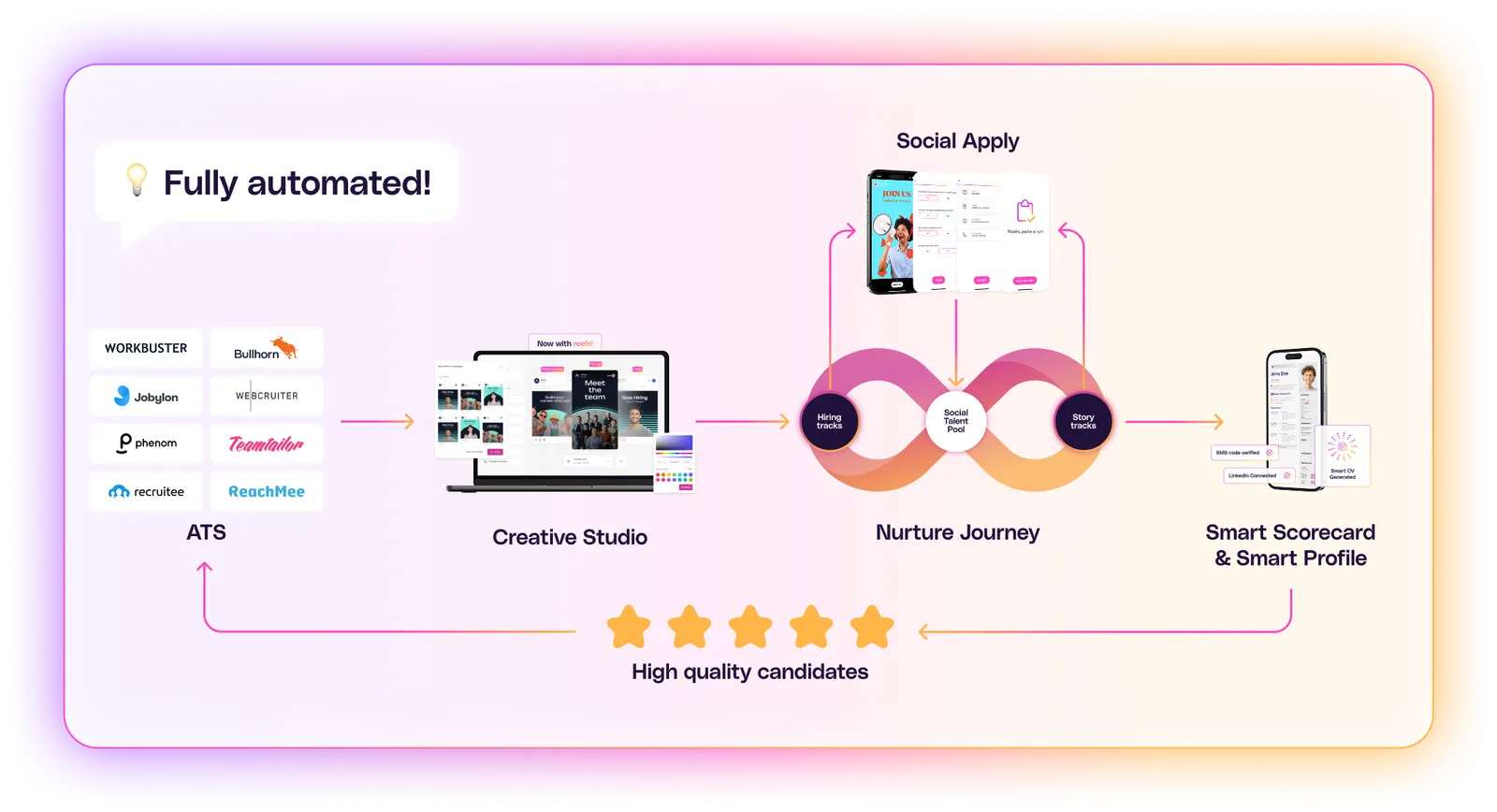
Adway exists to address what ATS systems cannot. It is not an ATS replacement. It is a social recruiting platform designed to control and optimise how candidates enter the hiring funnel.
Adway automates job distribution across social platforms and applies AI-powered recruiting logic to targeting, budget allocation, and performance optimisation. Instead of maximising reach, campaigns are adjusted based on real engagement and conversion signals.
This means fewer low-fit applications, less recruiter triage, and a stronger pool of candidates entering the ATS. When Adway is integrated with an ATS or recruitment CRM, the two systems work together rather than in parallel.
AI-Powered Recruiting That Improves Relevance
AI in recruitment is often misunderstood. Used poorly, it creates noise. Used well, it reduces waste. Adway applies AI to social recruiting with a clear goal: improve relevance at the top of the funnel.
Targeting is informed by candidate behaviour rather than static assumptions. Campaigns are adjusted continuously based on how people engage, apply, and progress. This helps surface higher-intent candidates earlier, reducing time spent on screening.
The result is better quality of hire without increasing workload. Organisations using Adway report an average return of €194 for every €1 invested, driven by reduced spend waste and stronger candidate fit.
Why ATS Buyers Should Pay Attention
Recruitment teams evaluating ATS systems are often trying to create order. But order alone does not improve hiring. Without control over sourcing and attraction, an ATS simply organises the symptoms of a deeper problem.
Adway addresses this by shaping who applies, not just how applications are handled. Social recruiting becomes measurable, optimised, and connected to real hiring outcomes rather than treated as a manual experiment.
This changes how the ATS performs. When better candidates enter the system, every downstream metric improves, from time-to-hire to hiring manager satisfaction.
Integration Matters More Than Replacement
Replacing an ATS is disruptive and expensive. Most organisations do not need to start over. They need their existing recruiting software to work better.
Adway integrates cleanly with leading ATS and CRM platforms, allowing teams to improve results without changing core workflows. Candidate data flows naturally into existing systems, and recruiters do not need to manage parallel processes.
This makes Adway a low-risk, high-impact addition to the recruitment stack, especially for teams under pressure to deliver results quickly.
The Future of Recruiting Software Is Modular
Modern recruitment technology is no longer a single system. It is a connected stack, where each component solves a specific problem.
The ATS manages workflow and compliance. The CRM supports long-term relationships. Adway controls attraction, targeting, and optimisation. Together, they form a hiring system that reflects how recruitment actually works today.
As competition for talent increases and budgets tighten, the ability to influence who enters the funnel becomes the defining advantage.
Why Adway Belongs on the Shortlist
If you are shopping for an ATS, you are making an important decision. But it is only half the decision. An ATS organises hiring. Adway determines whether hiring works.
Without a platform like Adway, even the best ATS remains dependent on manual posting, fragmented data, and guesswork. With Adway, recruitment teams gain control over reach, relevance, and performance.
For organisations planning their recruitment technology strategy for 2026 and beyond, choosing an ATS without considering how candidates are attracted is no longer enough. That is why Adway belongs on the shortlist.