
Employer Branding
SEBS meets Adway: why quality of hire starts with distribution
Sweden Employer Branding Summit (SEBS) put nine questions to Adway on talent acquisition and employer branding. The answers, in English: why quality of hire and Time to Attract are the KPIs that matter, how AI is reshaping both sides of recruitment, and why employer branding needs distribution as much as creation.
- Employer branding
- Talent acquisition
- Social recruiting
- AI in hiring
- Recruitment ROI
- Candidate experience
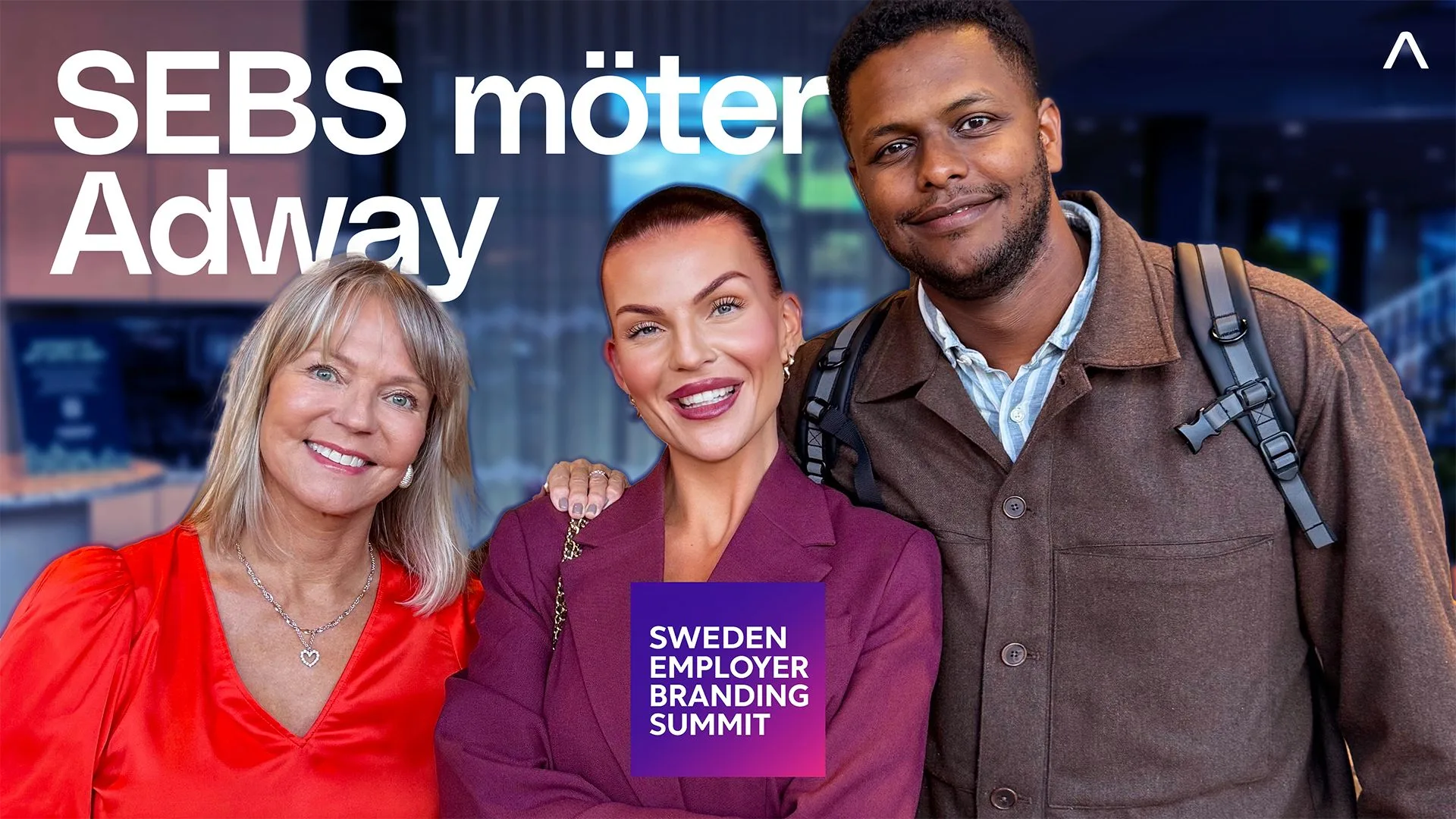
Sweden Employer Branding Summit (SEBS) is the annual meeting point for employer branding and talent acquisition professionals in Sweden. Ahead of this year's summit, the SEBS team met Adway for a conversation about what is actually changing in talent acquisition right now: rising application volumes, AI on both sides of the hiring process, and the growing gap between producing employer brand content and getting it seen.
The interview was recorded in Swedish. You can watch the full conversation below, and read Adway's answers to all nine questions in English underneath.
Key takeaways
- Quality of hire is the main focus for talent acquisition teams in 2026. With higher application volumes, the challenge is no longer getting more candidates but attracting the right ones from the start and identifying quality within the volume.
- Time to Attract and Quality of Hire are the two KPIs Adway recommends every TA team track: how fast you attract the right candidates, and what quality your talent attraction actually produces.
- AI has lowered the threshold to apply, so a single application says less about genuine interest and suitability than it used to. Recruiter time is shifting from administration to assessment, relationships and selling the employer to the right people.
- Candidates want simplicity and less friction. Most qualified candidates never visit a job portal; they discover employers in the same feeds where they consume everything else.
- Credibility is the next big employer branding question. When AI makes polished content effortless, real people and concrete proof of what it is like to work somewhere become more valuable, not less.
- Think as much about distribution as about creation. Around 70 to 80 percent of the talent market is not actively looking, so an employer brand that never reaches them creates very little value.
Watch the interview (in Swedish)
1. What is the most important focus for your customers in talent acquisition right now?
Quality of hire. In a world of higher application volumes, the challenge is not simply to bring in more candidates. It is to attract the right candidates from the start, and then to identify the quality within the volume.
For those of us working with AI-driven social recruiting technology, that work begins in distribution. By using data and programmatic technology to create and distribute campaigns on social platforms such as Meta, LinkedIn, TikTok and Snapchat towards relevant audiences, employers can reach the right talent where they already spend their time, including people who are not actively looking for a job.
At the same time, this builds something that is worth more over time: a social talent pool. Instead of starting from zero at every recruitment, the people who have shown interest are gathered in an owned, warmed-up talent pool that grows with every campaign. That is the difference between buying reach over and over again and building an asset the employer owns.
But targeting is only half the job. The next challenge is understanding which candidates are actually right for the role. Almost every customer we meet wants to measure quality of hire, yet the definition is still often subjective and differs between parts of the same organisation.
That is why we believe the main focus for talent acquisition has to be connecting the whole chain: which talent we reach from which channels, whom we attract, who progresses through the process, and who actually becomes a good hire. Only then can we use data to optimise targeting, the recruitment process and budget towards what genuinely creates quality. If you want a starting point, our guide to measuring quality of hire walks through the metrics that hold up in practice.
2. Which change in working life has the biggest impact on how you work with talent today?
AI is changing both sides of recruitment at the same time. For the candidate, the threshold for applying to many jobs has dropped considerably. That increases application volumes and means a single application says less about genuine interest and suitability than it did before.
For the employer, this shifts the focus from administering applications to identifying which candidates are actually relevant. The recruiter's time becomes more valuable in assessment, in the relationship, and in selling the employer to the right people.
At the same time, the jobs themselves are changing faster. Skills requirements and tasks can evolve at a pace that traditional role descriptions do not always keep up with.
Recruitment therefore becomes less a question of collecting as many applications as possible, and more a question of reaching the right people, identifying the quality within the volume, and building the relationship with relevant talent early, long before they apply for a job. This is the shift we explore in more depth in why employers need to focus on passive candidates.
3. Which behaviours or everyday actions build the culture at Adway?
Curiosity, trust and a strong appetite for experimentation. We are encouraged to test, build, fail, learn and improve.
"Here are the keys, see if you can do it better" sums up our culture fairly well. It creates a great deal of individual ownership, and an environment where new ideas actually get tested in practice.
4. Which two KPIs do you consider most important in talent acquisition?
Time to Attract and Quality of Hire.
Time to Attract measures how quickly an employer succeeds in attracting the candidate who applies for the job. It gives us a measure of how effectively we reach and spark interest among relevant talent, rather than how long the entire recruitment process takes. This is where programmatic distribution makes a real difference: by automatically reaching the right audiences on social media through always-on job ads, the path from open role to engaged candidate is shortened markedly.
Quality of Hire is then about the quality of the candidates we attract and ultimately hire. It is a KPI that almost every organisation we meet wants to get better at measuring, but where relatively few today have the infrastructure and a shared definition to follow quality consistently through the whole process. We have written a plain-English primer on what quality of hire is and how to define it.
Together, the two KPIs become particularly interesting: how quickly do we attract the right candidates, and what quality does our talent attraction actually create? For a wider view of the metrics worth tracking, see how to measure your talent acquisition efforts.
5. What do you see talent asking for most right now, and how do you respond?
Simplicity and less friction.
The candidate experience begins long before anyone clicks "Apply". In fact, a large majority of the most qualified candidates never visit a job portal. They discover employers and opportunities in the same digital environments where they consume everything else, and their expectations of simplicity follow them there.
That is why we need to see the whole journey from the candidate's perspective, from the first contact with the employer brand through to application and continued communication. Traditional recruitment processes do not always match the digital expectations people have today. Meeting the candidate on social media, with an application that is as simple as the rest of their digital life, is often the difference between reaching a passive talent and never being seen at all. Our quick guide to a better digital candidate experience covers the practical steps.
6. What have you tested that did not work as you expected, and what did you learn?
A good example is Adway Explore. We wanted to build on what we were already doing in advertising with a social career site, and created an extremely fast search experience, almost like Google for jobs. Technically, it worked exactly as we had intended.
What we had misunderstood was the problem itself.
A candidate does not come to a career site only to find a job. They also come there to make a decision. What is the culture like? How does the process work? What does the employer offer? What does it actually feel like to work there?
We had made search very efficient, but speed only solved one part of the candidate journey. The lesson was to start from what the candidate needs in order to make a decision, rather than from what is technically elegant to build.
7. How do you create better internal collaboration around employer brand and talent attraction?
Bring Marketing in much earlier. Talent Acquisition, HR and Marketing each own different parts of the same candidate experience, and they need to work far more closely together. After all, the candidate does not distinguish between the employer brand and the corporate brand. To them, it is all one brand.
That is also why we have built the Adway platform so that Marketing can easily be invited in and keep control of the brand, while TA can work quickly and independently. Content and campaigns are generated from the organisation's brand guidelines, so Marketing can feel confident that what goes out stays on brand even as the work scales across roles, teams and markets.
For us, good collaboration is therefore not about more approval rounds, but about setting the right framework from the start. Marketing should feel brand control, while TA gets the freedom and the technology to activate the employer brand towards the right audiences.
8. Which employer branding question do you think will become more important going forward?
Credibility.
When AI makes it very easy to create well-produced content, it also becomes easier to create content that feels perfect but generic. That is why we believe real people, real experiences and concrete proof of what it is actually like to work somewhere will become even more important.
AI can help us create more, and faster, but trust still has to be earned. In a world where almost anyone can create a perfect message, what genuinely feels true becomes considerably more valuable.
9. If you could leave one message with everyone working in employer branding in Sweden, what would it be?
Think as much about distribution as about creation.
Organisations can spend months on research, EVP work, concepts and creative material, and then invest far less effort in making sure the right talent actually gets to see the result. Given that around 70 to 80 percent of the talent market is not actively looking for a job at any given time, there is a real risk that the best material never reaches the people it was built for.
A fantastic employer brand creates very little value if the people you built it for never encounter it. That is why targeting and distribution on social media need to be part of the employer brand strategy from the beginning, not something added after the material is finished. We call this employer brand activation, and it is the gap most employer branding programmes still leave open.
A simple test: what share of the people you would actually like to hire has seen something from you in the last 90 days?
If you cannot answer that question, it may be high time to activate your EVP towards relevant talent pools on social media. A free social audit is a quick way to find out where you stand today.
Sweden Employer Branding Summit (SEBS) gathers Sweden's employer branding and talent acquisition community every year. Adway is an AI-powered employer brand activation platform, founded in Gothenburg in 2017 and named a Fosway 9-Grid Core Leader in Talent Acquisition for five consecutive years. Learn more about Adway.
Frequently asked questions
What is Time to Attract in talent acquisition?
Time to Attract measures how quickly an employer attracts the candidate who ends up applying for a role. Unlike time to hire, it isolates the attraction stage: how fast a vacancy reaches and engages the right talent. Programmatic distribution on social media shortens it by automatically putting the role in front of relevant audiences from day one.
Why is quality of hire so hard to measure?
Almost every organisation wants to measure quality of hire, but the definition is usually subjective and differs between teams in the same company. Measuring it consistently requires a shared definition and a connected data chain: which talent was reached from which channels, who applied, who progressed and who became a strong hire.
What is a social talent pool?
A social talent pool is an owned, pre-engaged audience of people who have shown interest in an employer through social media campaigns on platforms such as Meta, LinkedIn, TikTok and Snapchat. It grows with every campaign, so the employer does not start from zero at each new vacancy and does not have to buy the same reach again and again.
What share of the talent market is not actively looking for a job?
Roughly 70 to 80 percent of the talent market is not actively job-seeking at any given time. That is why employer branding content that only lives on a career site or job board rarely reaches the people it was built for, and why targeting and distribution on social media need to be part of the employer brand strategy from the start.
How should Marketing and Talent Acquisition work together on employer branding?
Bring Marketing in early. Candidates do not distinguish between the employer brand and the corporate brand, so TA, HR and Marketing are shaping one and the same experience. The best set-up gives Marketing brand control through shared guidelines while TA gets the freedom and technology to activate the employer brand towards the right audiences, without extra approval rounds.
Related reading
-
Best AI recruiting tools: Adway vs HeyJobs vs Gaia (Q4 2025)
-
Top Programmatic Social Media Job Advertising Platforms for 2025
-
10 Leading Recruitment Tech Companies for Programmatic Social Media Advertising
-
How Ocab Boosted Quality of Hire with Adway's Social Recruiting Technology
Want to see this in practice?